
February 28 is Maja day on the Swedish calendar, and I have some Majas to celebrate.
For those new to the name day concept, in many European countries each day of the calendar is associated with a few names. This originated with names associated with saints and is now another day to celebrate, similar to a birthday. As someone who likes dates, names, and celebrating people, I’m all for it. You can read a short description and look for names on various calendars here: https://www.behindthename.com/namedays/
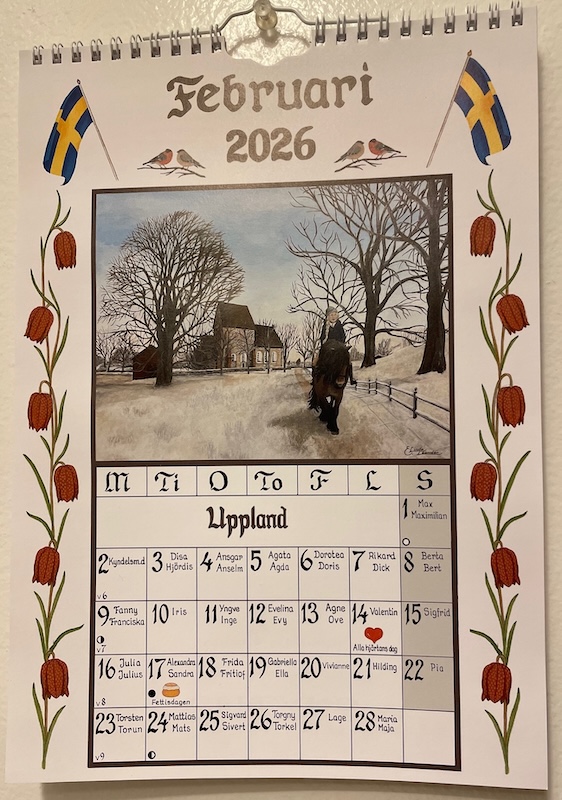
In Swedish, the letter J is pronounced like Y in English, so the name Maja is equivalent to the names Maya and Maia. However, Swedish speakers put a bit more stress on the second syllable so it sounds more like: my-YUH.
The first significant Maja for me was my six times great grandmother Maja Nilsdotter who lived in rural southern Sweden from 1713 to 1787. I first learned of her when I was a teenager helping my grandmother organize genealogy materials. My task was to look through documents to confirm names, places, and dates and to record sources. That was the beginning of my longtime love of genealogy research. I loved the patterns in the dates, the poetry of the names (I’m related to a Hannah Hand and an Essais Humble), and, most of all, the little clues that suggested stories.
One of those clues was a note next to Maja Nilsdotter’s name in a compilation of information sourced from original records. The note said “Little information. Maja could read her own books.” I was fascinated by the idea that a woman’s relationship to books was worthy of a note that persisted through centuries. Those words stuck with me. Many years later, I did research to better understand what the note might mean. It became even more mysterious when I learned that books were very expensive to produce and own at that time. By the 1780s Swedish people of all ages, genders, and classes were required to be able to read (so that they could read the bible), so the reading itself is not remarkable. But the idea that she owned books is.
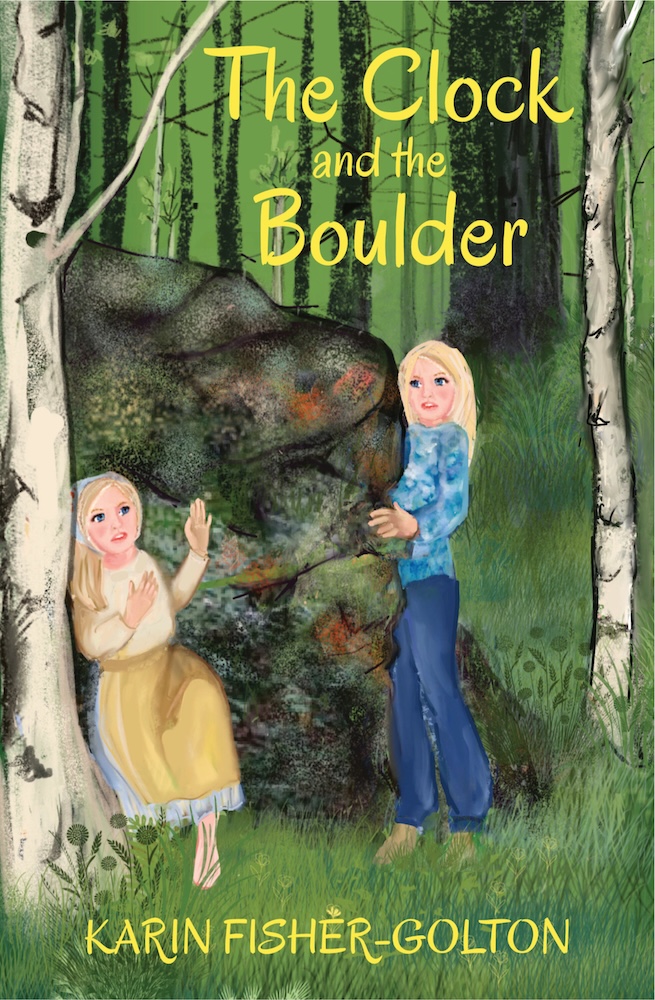
My middle-grade novel The Clock and the Boulder was partially inspired by a real farm in the area of Sweden where Maja Nilsdotter lived. Last I knew, it was owned by a distant cousin of mine and had been in my family for over three hundred years. The contrast between that geographic consistency with my more recent family history amazed me. I decided to explore this by writing about a modern girl, with a similar farm in her family, who moved often for a parent’s job but longed to stay in one place. She would time travel to that farm and meet a girl who longed for a life not bound by her own village. In honor of Maja Nilsdotter, I named the girl in the past Maja.
Like many authors, the more I work with my characters, the more I have a sense of them as distinct personalities. I became very fond of Maja, the character. She is clever and capable, and her curiosity helps her open her mind and her heart to a girl in strange clothing who mysteriously appears one morning by a special boulder. I imagine that Maja, the ancestor—who could read her own books—would be delighted that someday one of her descendants would write a book and name such a character after her. I celebrate both Majas today!


 Karin Fisher-Golton