Ars Novelica: Two Dogs, Alric and Pompe

I’m sharing a poem that is a tribute to two dogs, one fictional and one historical. It’s also a tribute to the enchanting connections that sometimes come when researching a novel.

This is another of my ars novelica poems—a term I coined for poems about the process of writing a novel, after ars poetica, a long-established term for poems about writing poetry.

Alric and Pompe
 
Fictional Alric barks in my head
I’ve left him out of my novel’s end
 
So I’m researching 1755 Sweden again
Would a family farm dog hang out in a house?
 
My fingertips tap the keyboard to search
And a real-life pup pops onto my screen
 
Pompe, companion of the Swedish naturalist
who coined the term Canis familiaris
 
Yes, Pompe and Linnaeus, an old story goes,
walked together each Sunday to church to attend
 
for exactly one hour, side-by-side in a pew,
then even mid-sermon, they’d get up and leave
 
And on weeks the biologist was home feeling ill
the canine was an hour-long churchgoer still
 
Historical Pompe cracks open the door
for my character Alric to saunter inside,
 
insert himself into a favorite scene,
and plop down at my protagonist’s feet

© Karin Fisher-Golton, 2025 

When I wrote The Clock and the Boulder I wanted to create an authentic sense of time travel, including accurate specifics of everyday life in 1755 rural Småland, Sweden. I researched details such as clothing, tools, home construction, and diet. In a later round of editing—long after I’d pored over an interlibrary loan book about Scandinavian footware and scooped up a used volume on Swedish quilts—I realized that I needed to know if an eighteenth century Swedish farm dog would be welcome in a house.

My internet search did not provide satisfying results. So I tried posting to the Swedish Traditions and Culture forum on Facebook. Not only did people have perspectives and anecdotes from their own family histories that suggested farm dogs would be welcome in a house, but a couple people alerted me to the story about the Swedish biologist Carl Linnaeus (1707–1778) and his dog Pompe, which is described in the poem. Linnaeus created the naming system and many of the scientific names for plants and animals still used today—including the scientific name for dogs themselves, Canis familiaris.

One detail that is not mentioned specifically in The Clock and the Boulder is that Alric is a Swedish Vallhund, a breed with a history in Sweden that goes back over a thousand years to the Viking days. You can read more about Swedish Vallhunds and enjoy some adorable photos here: https://www.akc.org/dog-breeds/swedish-vallhund/.

Here is how Alric is depicted on the back cover of The Clock and the Boulder by cover artist Marik Berghs. I could not find a portrait of Pompe, but I like that these two dogs now are connected, across time and imagination.

An illustration of a cheerful-looking Swedish Vallhund, a dog with short legs, prick ears, and German Shepherd coloring.
Illustration by Marik Berghs
from back cover of
The Clock and the Boulder
by Karin Fisher-Golton

For a thought-provoking poem by Laura Purdie Salas, in the form of a letter from peace to humans, plus links to to more poems on this Poetry Friday, visit Tabatha’s The Opposite of Indifference blog. Thank you, Tabatha, for hosting!

A star shape with a collage of images inside, including music notation and stars, also has the words "Poetry Friday" inside made of letters of a variety of colors and styles.
Art by Linda Mitchell
Posted in creativity, Karin's poetry, The Clock and the Boulder, writing process | Tagged , , , , , , , , , , , , , | 17 Comments

Spring Birds, Poetry, Book Launch

It’s the last Poetry Friday of National Poetry Month 2025 and the end of a week that included both Earth Day and the launch of The Clock and the Boulder, my time-travel novel for ages 9-12—a book that takes place at this time of year. To honor them all, I’m sharing a poem that I wrote a few years ago about one of my favorite features of spring. This all ties together in my head—April springtime, new beginnings, the natural world, and the rich details of language.

Birdsong on a Spring Morning

Tiny, full notes
sound like the starts
of pink, yellow, green
leaves, buds, blades of grass.

Listen, hear the wonders
of beaks and feathers
warming a small winged being.
And another answers back.

© Karin Fisher-Golton

To go with the poem and these themes, here is a detail from the back cover of The Clock and the Boulder. The protagonist loves sewing and animals. I was grateful that the cover artist, Marik Berghs, thought to bring those aspects together in this little image.

The image of a bird, with spirals and flower decorations above and below it, appears in an embroidery hoop.
The Clock and the Boulder, back cover, detail

See the full front and back covers on my Tuesday post, The Clock and the Boulder Is Launched!

And enjoy more poetry for this last Poetry Friday of National Poetry Month 2025 at Heidi Mordhorst’s wonderfully named blog, my juicy little universe.

A star shape with a collage of images inside, including music notation and stars, also has the words "Poetry Friday" inside made of letters of a variety of colors and styles.
Art by Linda Mitchell
Posted in Karin's poetry | Tagged , , , , , | 12 Comments

The Clock and the Boulder Is Launched!

The Clock and the Boulder, my time-travel novel for ages 9-12 was released today. It is now available as a paperback, hardcover book, and e-book.

I am delighted to have this longtime project come together so beautifully. Big thanks to Marik Berghs for her cover and interior artwork!

Visit here to read more about the book. Links to places where you can purchase it are there as well.

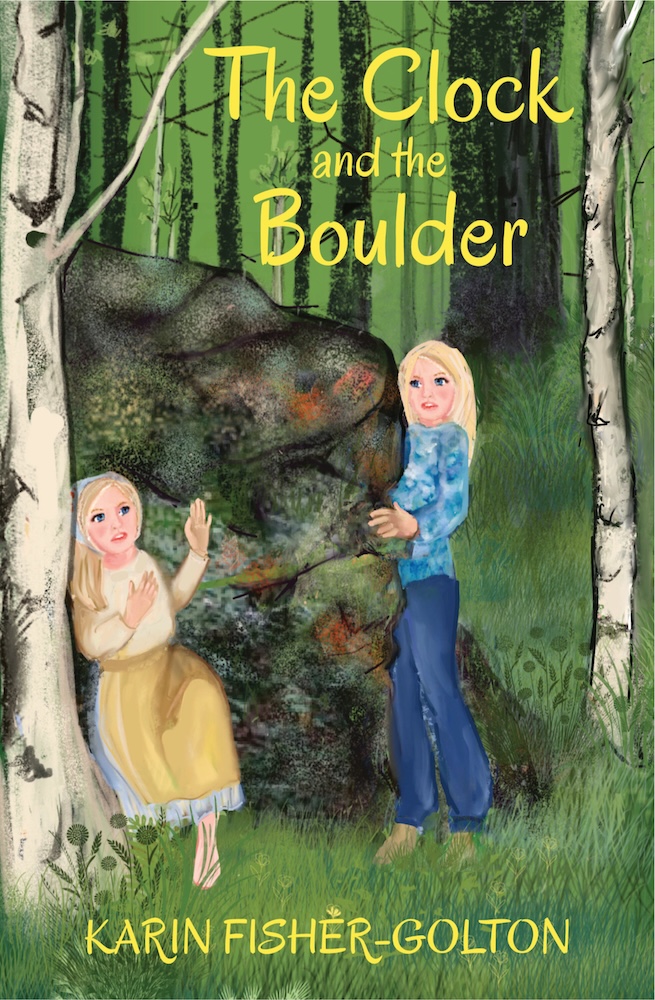
Book cover with title "The Clock and the Boulder" and author name "Karin Fisher-Golton." In a forest, a girl in a long-sleeved tie-dye shirt and sweatpants is peeking around the side of a large boulder. On the other side a girl in old-fashioned clothing holds up her hands. Both girls look startled.
The Clock and the Boulder (front cover)
The back cover of The Clock and the Boulder. Background is green with a few evergreen branches on the sides. The text can be found on the book's web page or in this blog post. Images on the edges are an embroidery hoop with a bird and spirals stitched in, a wooden bucket, a painted wooden Dala horse, and a Swedish Vallhund--a short dog with a curled tail.
The Clock and the Boulder (back cover)

Posted in The Clock and the Boulder | Tagged , , , , , , , | 4 Comments

Ars Novelica: Poems about Writing a Novel

I’m continuing to share poems connected to writing my novel, The Clock and the Boulder, in the lead up to its April 22 release in this National Poetry Month.

Book cover with title "The Clock and the Boulder" and author name "Karin Fisher-Golton." In a forest, a girl in a long-sleeved tie-dye shirt and sweatpants is peeking around the side of a large boulder. On the other side a girl in old-fashioned clothing holds up her hands. Both girls look startled.

Today I chose two short poems, both about aspects of the process of writing a novel. I think of them as “ars novelica,” a play on ars poetica, which is poetry about writing poetry.

I wrote the first one in February 2019, when I was toward the end of developing the story. I was quite taken with a little note I’d jotted down on a scrap of paper. It became the title of this poem. I like that the title is longer than any of the lines in the poem and has more specific detail than the poem itself.

Anders Will Need to Replace the Hay

a novel is born
and honed
via minutiae
and non-sequitur
captured on
scraps of paper

© Karin Fisher-Golton 

I wrote the second poem, a butterfly cinquain, this February during the time when I was putting the finishing touches on the text.

A cinquain is a poem with lines that have 2, 4, 6, 8, and 2 syllables in that order. A butterfly cinquain adds 4 more lines of 8, 6, 4, and 2 syllables. When these poems are centered, they look like sideways butterflies. I first wrote this one centered, but I like how it reads better this way.

Character

to start
a character
is a book problem solved,
quirky touches worked in, until
a shift
occurs, it has its own presence,
distinct from the author,
who’ll miss it at
the end

© Karin Fisher-Golton 

Enjoy more poetry this Friday and savor it into this mid-National-Poetry-Month weekend! The Poetry Friday round up is at Irene Latham’s Live Your Poem blog.

A small graphic that says "Poetry Friday." The "O" in "poetry" looks like a magnifying glass, and there is an image of an inkwell with a quill pen in it after the word "Friday."
Posted in Karin's poetry, The Clock and the Boulder, writing process | Tagged , , | 15 Comments

Time Travel! Book News and a Poem

Happy April 2025! It’s National Poetry Month and the publication month of my time-travel novel for ages 9-12, The Clock and the Boulder. This book, which will be released April 22, 2025, is set in the USA in 2016 and rural Sweden in 1755 and is about finding friendship and one’s own sense of home. You can read more about it here.

Book cover with title "The Clock and the Boulder" and author name "Karin Fisher-Golton." In a forest, a girl in a long-sleeved tie-dye shirt and sweatpants is peeking around the side of a large boulder. On the other side a girl in old-fashioned clothing holds up her hands. Both girls look startled.

In the many years I’ve spent working on this book, sometimes I’ve found it helpful and fun to write poetry as part of that process. Sharing some of that poetry seems perfect for this month.

I love the idea of time travel. Books allow us to travel through both time and space in our imaginations, both as readers and as writers.

The poem I share below does not represent a moment in The Clock and the Boulder, but part of the reality of some of its characters that would impact their lives and certain elements of the story. I enjoyed multiple journeys through time writing it and hope you will when you read it.

Winter Warmth, Sweden, ca. 1700

The earth of the hearth
is the stones—
cooled and crushed from the magma,
much later dug from the ground,
hefted, lifted, arranged,
adhered to form a safe container
and to guide smoke away.
And it is trees
grown in the soil
and fed by the sun,
cut, split, burned,
turned to ash
releasing warmth
to heat food
that fills bellies,
to warm flesh
through the long, cold winter.

The heart of the hearth
is the soul—
familiar family,
welcomed guests
gathered ‘round,
sewing, spinning, weaving
tinkering, mending, repairing
sharing food,
telling stories of the
family, folklore, religion,
singing songs
to lift spirits
through the long, dark winter.

© Karin Fisher-Golton 
A small graphic that says "Poetry Friday." The "O" in "poetry" looks like a magnifying glass, and there is an image of an inkwell with a quill pen in it after the word "Friday."


For more Friday poetry and abundant celebration of National Poetry Month, plus news of his new anthology of rainbow poems (what a topic!), visit Matt Forrest Esenwine’s Radio, Rhythm & Rhyme blog at https://mattforrest.wordpress.com/2025/04/03/poetry-friday-kicking-off-national-poetry-month-with-rainbows-and-a-story-about-lee-bennett-hopkins/.

Posted in Karin's poetry, The Clock and the Boulder, writing process | Tagged , , , , , , | 16 Comments

Trees!: California Lilac Poem on Tu B’Shvat

It’s the Jewish holiday Tu B’Shvat (the 15th of the Jewish month Shvat), called the birthday of the trees. Originally used for agricultural accounting, in modern times on this day we celebrate the many gifts of trees, including shade, food, beauty, inspiration, and oxygen in the air. Happy birthday and thank you, trees!

And in this secular month of February, my poetry group and I are in our twelfth year of a month-long poetry writing commitment. For me this year, it’s a poem every other day. Most years the two Ceanothus trees in my front yard show up in a poem. At this time of year, they are either getting ready to or beginning to blossom in my favorite color, purple.

A note: I usually call this family of trees and shrubs by its scientific name, Ceanothus, but I used its English name “California Lilac” for the title, because lilac is a shade of purple and California associates it with this place. I think they are called lilacs for the color and shape of the flowers. They don’t have that wonderful lilac aroma.

California Lilac

Ceanothus, densely dotted with pale buds
amongst little, leathery leaves
purple potential

buds burst to abundance
of blunt brush-like blossoms
purple profusion

fuzzy flowers, in sun’s heat, host
buzzing bees sporting pollen pantaloons
purple perpetuation

generations, variations, grow
on steep slopes, in clay soil, with scant water
purple persistence

© Karin Fisher-Golton, 2025
close up of tree with small dark green leaves and may pale lavender flower buds
Ceanothus “frosty blue” 2/12/2025, in the stanza 1/”purple potential” phase
A small tree filled with blueish-purple blossoms in a yard with a wooden fence behind it.
Ceanothus “Ray Hartman” 3/19/2024, in the stanza 2 / “purple profusion” phase

I’ll share this post for Poetry Friday tomorrow. For those looking for more Friday poetry that day, visit this week’s host Linda Baie at https://www.teacherdance.org for an abundance of poetry links.

Also blossoming is my communication about my writing. I’ve made an email list for those who want to keep the most up-to-date about my projects, with a particular focus now on my upcoming middle grade time-travel novel. More on that book here soon. I send occasional emails when I have something to share. You can click here for a little more information and the opportunity to sign up (if you haven’t yet): https://tinyurl.com/KarinSubscribe2.

Posted in garden, Karin's poetry | Tagged , , , , , , , | 14 Comments

Slippery, Spicy, Tingly: A Kimchi Mystery—RYWD Book Review

Happy Read Your World Day! This 13-year tradition of celebrating diverse children’s books, formerly called Multicultural Children’s Book Day, has a new name. The non-profit that organizes this event has become involved in more than the yearly celebration. Activities also include providing instructional materials and books to schools and libraries, curating book lists, spreading the word about diverse books and their authors through social media, and sponsoring the Pedro and Daniel Intersectionality Book Awards. (You can read more about all those activities here.) They’ve long had the motto “Read Your World,” which I love. To me it both means read about the world that reflects yourself and means read about the diversity that exists in the world we live in. It is now the name of the organization and the day.

As you may know, I’ve been proud to volunteer for Read Your World for many years and have served on its Board of Advisors since 2020.

This year, I thank Lerner Publishing/Carolrhoda Books for sending me a copy of the picture book Slippery, Spicy, Tingly: A Kimchi Mystery by author-illustrator Yangsook Choi. On the surface it is the story of a boy’s lively halmoni (grandmother in Korean) visiting and making kimchi with him and his parents in the traditional way, but it is so much more—all within the compact picture book format.

A young boy, squatting, peers over the side of a basement staircase. At the bottom is a woman with short, gray hair standing behind a pile of cabbage that goes up to her waist. More cabbages are in piled boxes to her side.
Slippery, Spicy, Tingly by Yangsook Choi, cover image

What I love most about Slippery, Spicy, Tingly is that it is a sensory experience! Those words in the title come up not only related to kimchi, but to elements of Halmoni’s personality and the boy protagonist Keo’s experience. There are other wonderful sensory details as well, such as the smell of dirt, the tickling of feet, and the crunch of kimchi that isn’t ready yet. This book would make a great starting point to invite children to notice these kinds of details and the words we use to describe them, either at school or at home.

A mother and son are sitting at a kitchen table, with an open jar of red kimchi, two chopsticks sitting in it. The boy seems to have some on toast. Over their heads is the words to a song about loving kimchi. They look in surprise toward the door, where an older woman with short gray hair, bundled up and carrying a package is walking in. The text begins: "I was singing my song one frosty morning when Halmoni burst through the door."
Slippery, Spicy, Tingly by Yangsook Choi, interior spread

I always appreciate a layered grandparent character in a children’s book, and Keo’s halmoni certainly fits that description. Keo wonders about his importance in her full life. Some of her actions are mysterious him. They include digging a pit in his back yard and putting a giant clay jar inside! He comes to see that her process of making traditional kimchi not only results in one of his favorite foods, but is an act of love.

Though I’ve never made kimchi, I have made sauerkraut, and I can attest to how fascinating and delicious the fermentation process is. I know it to be quite nutritious as well. Yangsook Choi portrays all these aspects deftly within the story, in ways children can understand without a sense of being lectured. Her Author’s Note at the end provides more information.

I recommend Slippery, Spicy, Tingly for those interested in sensory adjectives, family traditions, Korean traditions, nutrition, fermented foods, and, of course, kimchi.


Read Your World 2025 (1/30/25) is in its 13th year! Valarie Budayr and Mia Wenjen founded this non-profit children’s literacy initiative; they are two diverse book-loving moms who saw a need to shine the spotlight on all of the multicultural diverse books and authors on the market while also working to get those books into the hands of young readers and educators.

Read Your World’s mission is to raise awareness of the need to include kids’ books celebrating diversity in homes and school bookshelves. Read about our Mission and history HERE.

Read Your World is honored to be Supported by these Medallion:

FOUNDER’S CIRCLE: Mia Wenjen (Pragmaticmom) and Valarie Budayr (Audreypress.com)

🏅 Super Platinum Sponsor: Author Deedee Cummings and Make A Way Media

🏅 Platinum Sponsors: Publisher Spotlight and  Language Lizard Bilingual Books in 60 Languages 

🏅 Gold Sponsors:  Third State Books 

🏅 Silver Sponsors: The Quarto Group, Red Comet Press and Lerner Books 

🏅 Silver Corporate Sponsor:  Scholastic Books 

🏅 Bronze Sponsors:  Lee and Low and Star Bright Books

🏅 Bronze Corporate Sponsor: Crayola Education 

🏅 Ruby Corporate Sponsor: MagicBlox

Read Your World is honored to be Supported by these Author Sponsors!

Authors: Stephanie M. Wildman, Martha Seif Simpson, Anna Jennings, Gwen Jackson, Afsaneh Moradian, Joaquín Camp, Rahana Dariah, Ziggy Hanaor, Josh Funk, Nancy Tupper Ling, Kathleen Burkinshaw, Gea Meijering, Eugenia Chu, Dorktales Story Time, Amanda Hsiung-Blodgett, Authors J.C. Kato and J.C.², Cynthia Levinson, Diana Huang, Rochelle MelanderLisa Chong, Lisa StringfellowBrunella Costaglioga, Lindsey Rowe Parker, Rachel C. Katz, Tonya Duncan Ellis, Shifa Safadi, Lisa Rogers, Sylvia Liu, Eva Clarke, Crystal Murakami, Teddi Ahrens

Read Your World is Honored to be Supported by our CoHosts and Global CoHosts and by our Partner Organizations! 

Check out RYW’s Multicultural Books for Kids Pinterest Board!

📌 FREE RESOURCES from Read Your World Day

📌 Register for the Read Your World Virtual Party:  https://readyourworld.org/virtualparty 

Join us on Thursday, January 30, 2025, at 9 pm EST celebrating 13 years of  Read Your World Day Virtual Party! Register here.   

This epically fun and fast-paced hour includes multicultural book discussions, addressing timely issues, diverse book recommendations, & reading ideas.

We will be giving away a 10-Book Bundle during the virtual party plus Bonus Prizes as well! *** US and Global participants are welcome. **

Follow the hashtag #ReadYourWorld to join the conversation, and connect with like-minded parts, authors, publishers, educators, organizations, and librarians. We look forward to seeing you all on January 30, 2025, at our virtual party!

Find reviews on the Big Giant Linky, here: https://readyourworld.org/2025-big-giant-linky/

Posted in cooking, Multicultural Children's Book Day, Read Your World Day, uncategorized | Leave a comment

Progressive Poem 2024/National Poetry Month

We are coming into the last weekend of National Poetry Month. It’s an opportunity to revisit some favorite poems, read the work of a poet you’ve wondered about, write a poem yourself, or check out the links for this week’s Poetry Friday and see what you discover. Ruth is hosting Poetry Friday at her blog, “There is No Such Place as a God-Forsaken Town.”

Part of how I’m celebrating is by participating in the the 2024 progressive poem. Poet and author Irene Latham began a progressive poem tradition in 2012 “as a way to celebrate National Poetry Month (April) as a community of writers” in the Kidlitsophere (world of children’s literature blogs). A different blogger poet hosts the progressive poem each day in April and adds to a group poem. Irene headed up the project from 2012 to 2019 (archive here). And Margaret Simon took over the organizer role in 2020 (see that poem and links to later ones here).

Most years each poet writes a line, but this year Patricia Franz began with a couplet (a pair of lines) and a call for a real-life world theme. Soon a narrative poem was developing on the serious topic of children with, as Carol Varsalona describes in her April 14 couplet, a “no-choice need to escape.” Most (maybe all) of us are writing outside our lived experience, but as people who write for children, the multitude of children who are impacted by and have been impacted by such dire situations weigh heavily on our hearts. Wishes for catalysts of hope and moments of respite come through.

On April 6, organizer Margaret Simon grouped the couplets into quatrains (four-line stanzas), which gave the poem structure and helped bring focus to the narrative.

Below is this year’s poem, so far, with my new couplet italicized at the end.


cradled in stars, our planet sleeps,
clinging to tender dreams of peace
sister moon watches from afar,
singing lunar lullabies of hope.

almost dawn, I walk with others,
keeping close, my little brother.
hand in hand, we carry courage
escaping closer to the border

My feet are lightning;
My heart is thunder.
Our pace draws us closer
to a new land of wonder.

I bristle against rough brush—
poppies ahead brighten the browns.
Morning light won’t stay away—
hearts jump at every sound.

I hum my own little song
like ripples in a stream
Humming Mami’s lullaby
reminds me I have her letter

My fingers linger on well-worn creases,
shielding an address, a name, a promise–
Sister Moon will find always us
surrounding us with beams of kindness

But last night as we rested in the dusty field,
worries crept in about matters back home.
I huddled close to my brother. Tears revealed
the no-choice need to escape. I feel grown.

Leaving all I’ve ever known
the tender, heavy, harsh of home.
On to maybes, on to dreams,
on to whispers we hope could be.

But I don’t want to whisper! I squeeze Manu’s hand.
“¡Más cerca ahora!” Our feet pound the sand.
We race, we pant, we lean on each other
I open my canteen and drink gratefully

Thirst is slaked, but I know we’ll need
more than water to achieve our dreams.
Nights pass slowly, but days call for speed
through the highs and the lows, we live with extremes

We enter a village the one from Mami’s letter,
We find the steeple; food, kindly people, and shelter.
“We made it, Manu! Mami would be so proud!”
I choke back a sob, then stand tall for the crowd.

A slapping of sandals… I wake to the sound
of ¡GOL! Manu’s playing! The fútbol rebounds.
I pinch myself. Can this be true?
Are we safe at last? Is our journey through?

I savor this safety, we’re enveloped with care,
but Tío across the border, still seems far as stars.


You can follow the progression of the 2024 poem at these blogs:

April 1 Patricia Franz at Reverie
April 2 Jone MacCulloch
April 3 Janice Scully at Salt City Verse
April 4 Leigh Anne Eck at A Day in the Life
April 5 Irene at Live Your Poem
April 6 Margaret at Reflections on the Teche
April 7 Marcie Atkins
April 8 Ruth at There is No Such Thing as a God Forsaken Town
April 9 Karen Eastlund
April 10 Linda Baie at Teacher Dance
April 11 Buffy Silverman
April 12 Linda Mitchell at A Word Edgewise
April 13 Denise Krebs at Dare to Care
April 14 Carol Varsalona at Beyond Literacy Link
April 15 Rose Cappelli at Imagine the Possibilities
April 16 Sarah Grace Tuttle
April 17 Heidi Mordhorst at my juicy little universe
April 18 Tabatha at Opposite of Indifference
April 19 Catherine Flynn at Reading to the Core
April 20 Tricia Stohr-Hunt at The Miss Rumphius Effect
April 21 Janet, hosted here at Reflections on the Teche
April 22 Mary Lee Hahn at A(nother) Year of Reading
April 23 Tanita Davis at (fiction, instead of lies)
April 24 Molly Hogan at Nix the Comfort Zone
April 25 (missed day)
April 26 Karin Fisher-Golton at Still in Awe
April 27 Donna Smith at Mainly Write
April 28 Dave at Leap of Dave
April 29 Robyn Hood Black at Life on the Deckle Edge
April 30 Michelle Kogan at More Art for All

Posted in creativity, Karin's poetry, others' poetry | Tagged , , , , , , , | 22 Comments

Small Rescue

Last night I found one of those insects some call a “daddy long legs” and some call a “mosquito eater” in my bathroom. I hadn’t seen one for years, and it was a welcome sight reminding me of long ago stays in woodsy cabins that were not well-sealed from the outdoors. But for a number of reasons, I thought it would be best if its visit to the bright small room was brief. I was sure to leave the door wide open and the alluring light fixture off, hoping it would find its way to a spot near a door where we could let it outside. Later, I didn’t see it in the bathroom and imagined it was on its way.

But in the morning, I found it, by the window—in a corner that wouldn’t allow for me to catch it in a yogurt container and take it outside. On a closer look, I realized there was a half-peanut-sized ball of spider web stuck to the tip of one of its back legs. I wondered if the weight of that web could keep an insect from moving.

Since the insect was so still, I tried giving the web ball a tug. But the long spindly leg just pulled out straight, well-stuck to the web. The insect was clearly alive, and I was surprised my tug didn’t get it at least trying to fly away. Now I was in full problem-solving mode. I got scissors, thinking I might cut off most of the web and at least lighten its load. Kudos to the spiders, because web is apparently right there with rock, beating scissors. The scissors didn’t slice the web, but the experience got the insect moving, which I was glad to see. It took a short flight to the shower curtain. Now I could get the yogurt container, thinking that if this creature was going to live out its life burdened by a knob of web, at least it could do so outside.

I got the insect into the container easily, put on the lid to keep it there, walked down the hall, and opened the front door. When I looked down at the lid I was about to remove, a half-peanut-sized ball of spider web caught my eye. Could that be the same web, perfectly situated on the edge of the lid, with the insect inside? Probably another piece of debris, I thought, but I pulled it off with a small tug. Then I opened the lid. A blur zipped to the loquat tree by my front porch.

I looked and saw the now familiar insect, with six long web-free legs, sitting on the leaves of the loquat tree.

Mass of large dark green loquat leaves is soft morning light.
Photo of the same loquat tree, taken soon *after* the insect had flown away.
Posted in garden | Tagged , | 2 Comments

Bay Couple, a Persona Poem

Last month, walking on Wildcat Creek Trail near where I live in the San Francisco Bay Area, I spotted this pair of bay trees by the side of the path.

Two bay trees are in gentle shade, the edge of a grassy sunlit path shows on the right. One bay has multiple thin trunks, one of which curves around the much wider trunk of the other bay, which has a bend below the first bay's branch and leans toward that branch.
photo © Karin Fisher-Golton, 2024

I was quite taken with them and later wrote the persona poem below. (In persona poems, poets write from the point of view of someone or something other than themselves.) Though it didn’t make it into the poem, I think of that bright red leaf on the right as a heart.

Bay Couple

we reside
alongside the wide path
where we hear talk
of the narrow paths above
with city and bay views,
bay like our name,
but we are solid,
only the sharp smells of our leaves flow
unlike that other bay
that we understand to flow
with vast amounts of water, the rain stuff

many pass us by on the wide path
jackrabbits, coyotes,
mule deer, turkeys,
garter snakes, foxes,
the occasional mountain lion,
hawks and vultures, high above,
the small flittering birds,
who land lightly on our branches
to rest or build nests in our bends
and grow their young

mostly in the light hours
humans travel the wide path too,
all sorts of humans, in their bright coverings,
some speeding by on objects called bicycles,
some walking singly or in packs of all sizes

and sometimes a couple of them
stop nearby
they speak in tones, low as a far wind,
then quiet like the time
after the owls and before the crows
and tangle their limbs together
in close connection, called a hug

but few stop to notice
that I have tangled my limbs with older bay,
over these many years,
older bay, who once leaned into
another bay, now long gone,
in this time, these days, these seasons
we two intertwine our twigs,
rooted here, alongside of the wide path

© Karin Fisher-Golton, 2024

Find links to more poetry for Poetry Friday at Tricia Stohr-Hunt’s The Miss Rumphius Effect blog where she writes about pantoum poems, shares one herself, and has links to those by others in her group—plus many links to other poems. I love pantoums, and though I’m not sharing one here, it strikes me that my bay friends’ tangled limbs are reminiscent of pantoum stanza’s tangled lines.

Posted in Karin's poetry | Tagged , , , , , , | 20 Comments