A Poem a Day for February

Last year the members of my children’s poets group set out to write a poem a day in February. All four of us did just that. Some days one of us wrote two.

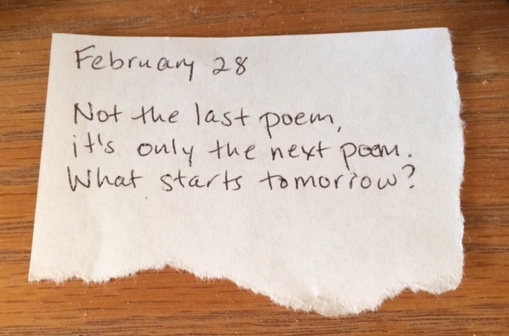
On the last day I wrote a poem called “February 28.” It reminded me of accomplishment and possibility. I transcribed it onto a scrap of paper and put it in a central location on my desk where it has stayed for eleven months.

Poem by Karin Fisher-Golton, 2/28/2014

Poem by Karin Fisher-Golton, 2/28/2014

A new February is about to begin, and we’ve decided to do the same exercise again. Last year at this time, the goal seemed daunting. I was making plans for how I’d keep going and encourage others to keep going when we got stuck or distracted and didn’t write poems for days. None of those plans were necessary.

Now I’m just excited that it’s almost February.

This is a good moment to express my appreciation and esteem for the other three poets in my group: Sheri Doyle, Judith Gamble, and Carol Shank. I am fortunate to study poetry with, be inspired by, and enjoy the friendship of these three talented women. Thank you, Sheri, Judy, and Carol!

This week’s Poetry Friday host is Paul Hankin’s These 4 Corners blog.

Posted in Karin's poetry | 5 Comments

Stay Calm, Leave Room For Gratitude

(This post is identical to the one I posted earlier today on my book’s blog, OurAmazingDays.com. The two blogs overlap so much, a merge may be forthcoming. Meanwhile, I want to share this here, too.)

I’ve been noticing lately that “stay calm” is a great lesson of parenting. Things just work better when I stay calm. With parenting there are so many opportunities to practice: Stay calm when your precious child is bleeding and sobbing. Stay calm when your innocent child says something completely inappropriate for a situation. Stay calm when your adorable child makes a mess that you never thought possible. Stay calm when your sweet child whines with a marathon runner’s tenacity. Stay calm when you realize you forgot to stay calm.

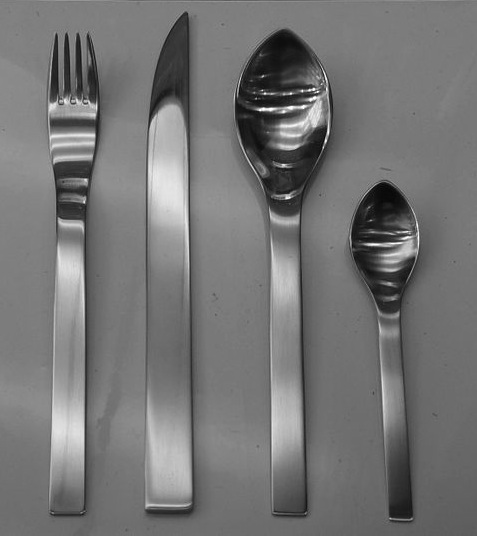
I was contemplating this just last night. That turned out to be fortunate timing because this morning, when my 9-year-old son and I were putting away clean dishes and I was facing away from him, I heard a very loud crash with metallic tinkling overtones. Without turning around I said aloud, “I think I just heard the sound of the silverware drawer falling on the floor…now I’m going to turn around and see what that looks like.” In that brief moment I’d taken, I’d already reminded myself to stay calm, which was a good thing because not only did I see the silverware all over the floor, but I saw sharp knives next to my son’s sock-clad feet.

I asked him to notice the knives and walk carefully away. In an alternative not-so-calm universe I would have had dramatic and loud things to say, that would have included keeping him out of the room entirely, while I fixed everything myself, perhaps alternating with demanding he do some particular task in a stressed-out voice.

Instead, I asked him to get a dish towel from the drawer in the dining area so that we could put the clean silverware from the dishwasher on the towel to make room in the dishwasher for the silverware on the floor. While he was out of the room, I picked up the knives. Then we started cleaning up together.

I didn’t point out that it’s not a good idea to pull out the drawer vigorously. I think he already got that message. In fact, I think being calm left space for it to sink in.

Being calm, also left space for gratitude—gratitude the knives hadn’t landed on his feet, gratitude I’d remembered to stay calm, gratitude that he could help in this situation, gratitude for the opportunity to remind him and myself that when we make mistakes we can just simply fix them, gratitude for his good company.

What could have been an unpleasant interlude turned into a sweet time together.

512px-Jean_Nouvel_silverwareWarburg

photo by Warburg


Posted in gratitude | Leave a comment

Amazing May Posts

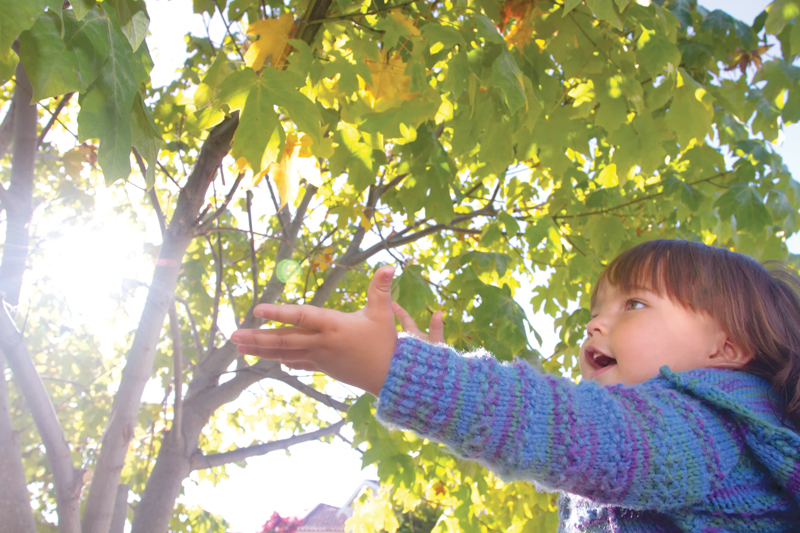
photograph by Lori A. Cheung from My Amazing Day by Karin Fisher-Golton, Lori A. Cheung, and Elizabeth Iwamiya ©2013

photograph by Lori A. Cheung from My Amazing Day by Karin Fisher-Golton, Lori A. Cheung, and Elizabeth Iwamiya ©2013

I started a blog on OurAmazingDays.com, the website for my book, My Amazing Day: A Celebration of Wonder and Gratitude. I’m launching with a month of daily posts about amazing things–clearly relevant topics to my Still in Awe Blog here. I hope you’ll visit, enjoy the posts, and add some comments.

Below is a list of the posts. Or peruse them on pinterest: http://www.pinterest.com/karinfg/amazing-may/pins/

Amazing May 1: Babies, Toddlers, and Wonder
Amazing May 2: Color
Amazing May 3: Written Language
Amazing May 4: Being Ready
Amazing May 5: Breathtaking Scenery
Amazing May 6: Food Plants
Amazing May 7: Community
Amazing May 8: Modern Genealogy Resources
Amazing May 9: Avocados (with poem)
Amazing May 10: Baseball
Amazing May 11: Mothers and Motherhood
Amazing May 12: Music
Amazing May 13: Yogurt
Amazing May 14: Smell–The Time Traveling Sense
Amazing May 15: Becoming Friends (with Fibonacci poem)
Amazing May 16: Children’s Books
Amazing May 17: Rainbows
Amazing May 18: Humor
Amazing May 19: Our Place in the Universe
Amazing May 20: Sunrises and Sunsets
Amazing May 21: Glasses
Amazing May 22: Telecommunication
Amazing May 23: Joyous Occasions (with found poem)
Amazing May 24: Happy Memories
Amazing May 25: Pets
Amazing May 26: Bravery
Amazing May 27: Birds
Amazing May 28: The Night Sky
Amazing May 29: Creativity (with ekphrastic poem)
Amazing May 30: Our Relationships With Ourselves
Amazing May 31: Commitment

Posted in gratitude, My Amazing Day | Leave a comment

An Ekphrastic Pantoum on February 27

My children’s poets group is finishing up writing a poem a day for the month of February. When we started I wondered how many poems we would actually write. Turns out we’ve each written a poem a day, sometimes two. Between the four of us we have written over a hundred poems this month. It’s been a rich experience in so many ways.

Today I wrote an ekphrastic poem (a poem inspired by a piece of art) on Grant Wood’s painting Spring Turning. You can view the painting here: http://www.reynoldahouse.org/collections/object/spring-turning. I decided to write it as a pantoum, a form I’ve long enjoyed and admired, but felt daunted to try. (In a pantoum the second and fourth lines of one stanza are repeated in the first and third lines of the next stanza.) Thanks to being on day 27 of a poem a day, I put “daunted” aside, and wrote.

poetry fridayThank you to Anastasia Suen for hosting Poetry Friday. Visit http://www.pinterest.com/anastasiabooks/poetry-friday-22814/ for plentiful links to poetry.


Pantoum on Spring Turning
     inspired by Spring Turning by Grant Wood, 1936

pulling plows, preparing for planting
around the edge of a grand square they go
horses are a farmer’s helpmates
turning hills of grass to growing places

around the edge of a grand square they go
working horses who sleep in warm barns
turning hills of grass to growing places
hills to be filled with food

working horses who sleep in warm barns
pulling plows, preparing for planting
hills to be filled with food
horses are a farmer’s helpmates

© Karin Fisher-Golton, 2014
Posted in Karin's poetry | 14 Comments

Metal Bowls and Memories

My family and I are making room for the coming multitude of My Amazing Day board books, so on Sunday we had a garage sale. We did fine with sales, but when it was over there was also quite a lot left. Gung-ho to clear space we made some quick decisions, and packed most of it in the car to take for recycling and donations. My husband Joe found out that the recycling center was open until 4:30pm, so while he finished cleaning at home, I quickly headed off with the Oakland A’s division-clinching game on the radio.

The woman in the back of the Goodwill truck was helpful. I handed up bags, boxes, and loose items. She explained that she couldn’t take aluminum lawn chairs but they could be recycled in a nearby bin. She pointed out another bin for electronics items.

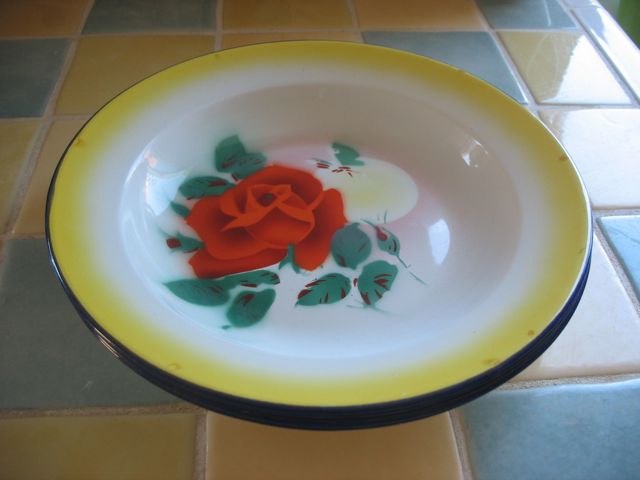
It wasn’t until I was on the way home and the A’s were celebrating, that I reviewed what I had just given away and began to feel anxious about giving away a few of those items, particularly some decorated enamel-on-metal bowls. My mother and I had bought those bowls long ago at a small store, called Peking Duck, on Solano Avenue in Berkeley. Long gone now, the store sold imported items from China. Not the “made in China” stuff that could be from anywhere, but real Chinese crafts which the friendly proprietor often had something to say about. We appreciated the variety of designs in those bowls, the way they stacked so neatly, and how sturdy they were. They ended up following me out of the house, through various meals, camping trips, potlucks, and relationships.

As the evening continued, the anxiety about the other items faded away, but the emotion about the bowls was distinct, not just in my head, but fluttering in my chest, and heavy in my stomach. After decades of experience being a sentimental person, I usually am quite good at identifying the items I don’t want to part with. It bothered me that I’d not even noticed an inkling about the bowls until it was too late. I told my Mom and Joe about this, ending with “…and there’s no way they could even be found in that big truck.”

When I woke up this morning, and the bowls drifted into my thoughts, it occurred to me that since I had dropped the boxes at the end of the day, as of this morning the bowls’ box might not be buried in the truck. What seemed impossible last night, seemed possible this morning. I decided to put my mind’s chatter about overvaluing material objects aside, and just go for it.

By the time I walked my son to school, attended the brief morning assembly, walked home, and drove to the recycling center, it would have been open for nearly an hour. Getting there earlier would help, plus I wanted to minimize the impact on other parts of my day. I asked my ever-more independent, third grade son if he’d feel comfortable being dropped off at a gate. He answered, “Sure!” After some discussion about how weird it felt to drive and debate about where to drop him off, we did it. I watched him walk off on his own, struck by how much more okay that felt than the one other time I did it a few years ago. My confidence that he would reach his classroom this time was complete.

I drove on to the recycling center. As I’d hoped, it was not crowded. Another attendant was in the Goodwill truck, equally helpful. I briefly explained my situation. He asked me to describe the box, as I wasn’t allowed to look for it myself. It was a pretty regular box, but I’d handed it up yesterday with a dish drain sitting on top. First I spotted my son’s little-guy sleeping bag. It was very close to the front. Then I could just see the edge of dish drain. The attendant handed me the box underneath.

At first I’d thought I had the wrong box. I’d expected it to be full of kitchen items wrapped in paper. But then I remembered stuffing that mattress pad on top. I started to reach under the pad to feel for the shape of the bowls wrapped in paper, but instead found the whole stack of bowls right there, stuffed in a fold of the mattress pad. I’d forgotten, that the decision to give away the bowls and their packing had been that hasty. I pulled them out, glad to feel them in my hand, then went to the car and reviewed all the designs, remembering places where they had been and people who’d shared meals served in them.

I drove home on this sunny morning, in awe of how this thing that had seemed impossible had happened, wondering what it might come to mean to me. One thing that struck me is that this is a story of overcoming false limitations—the bowls weren’t impossible to find in that big truck, I didn’t have to wait until after the normal school drop off to go. After I got home I felt a little sad I hadn’t taken a photo of the old sleeping bag. I realized that was because it was linked to my son’s first camping trips. For the second time in twelve hours an emotion hit me hard, again in my chest, but this time with warmth, and it brought tears to my eyes. These objects mean something to me because they are linked to memories of often seemingly simple moments. I got how profoundly sweet it is to have so many precious memories.

Metal bowls1 Metal bowls2

Posted in uncategorized | 1 Comment

Goodbye and Thank You, Eastern Span of the Bay Bridge

EasternSpanBB2

I’m feeling sentimental about the eastern span of the San Francisco-Oakland Bay Bridge. Today is the last day it will carry traffic.

My earliest memories of the bridge are as a child, slumped in the back seat on long rides home to Berkeley from San Francisco or beyond, down on the lower deck where both spans look the same. Other than the tunnel through Yerba Buena Island and some glimpses of views between cars and girders, it could be a monotonous ride. But I’d found a way to make it fun. I’d discovered that the underside of the upper deck had sequentially numbered beams. I entertained myself by reading the numbers and seeing how high they would go before they restarted. A few weeks ago, crossing the bridge on the lower deck from my modern-day position in the driver’s seat, I heard my 8-year-old son and his friend refer to “the never-ending bridge” with fondness. I could relate.

The eastern span has been the less glorious half of the Bay Bridge to be sure, and since it showed its vulnerability in the Loma Prieta earthquake in 1989, over half my life ago, its days have been numbered. Not new to sentimentality, I never sat comfortably with that plan—even before the ridiculous costs and delays.

The impending absence made my heart grow fonder. I realized that on the upper deck I enjoy the geometric patterns, changing like a kaleidoscope as you drive along. A few years ago I was fortunate to be sailing under the bridge in a friend’s boat. I noticed that the eastern span’s supports sport the design element of criss-crossing metal between two sides that is in the towers of the western span. I liked that the two halves were visually tied together.

Crossing the eastern span in recent years has offered the opportunity to witness a bridge being built up close (the new eastern span). I am impressed with people who create bridges. There is a certain audacity in building something over water that will hold the weight of concrete and millions of cars and people passing over.

The new span, which I’ll miss getting to view from the old one, is a beauty. Despite its crazy costs and timeline, I am growing fond of it already.

But for today, I say goodbye and thank you to the original eastern span of the Bay Bridge. Thank you for getting me and so many others to and from San Francisco, Oakland, and points beyond—for work, for visits with friends and family, for life events, for sights and music. Thank you for the views and the counting opportunities. Thank you for being part of the Bay Area.

EasternSpanBB1

Posted in uncategorized | Leave a comment

Butterfly Words

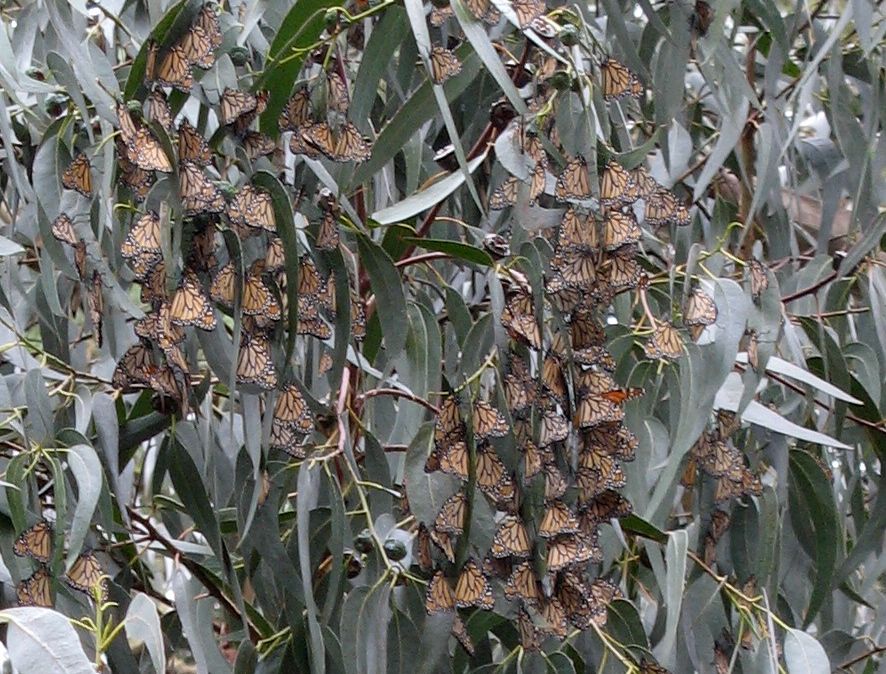
Monarch butterflies, Monterey, California, Nov. 2011

Monarch butterflies, Monterey, California, Nov. 2011

My love of butterflies began with language. One late spring day in 1997 I was on a group hike, celebrating a friend’s birthday. Someone saw a butterfly and mentioned that he liked the French word for it: “papillon.” I shared that I’d long been partial to the Spanish word, “mariposa.” I realized there were people from several countries on the hike and got curious about their words for butterfly. Before the hike was over, I knew “farfalla” (Italian), “schmetterling” (German), “falter” (also German), and “leptir” (Serbo-Croatian).

Learning words for butterfly became a hobby. I called it my “butterfly collection.” When I heard people speak with accents, prior to this interest I’d feel shy about asking where they were from, but now I had a reason to ask, and ask I did. In a few years I learned thirty-five words for butterfly.

A few of my favorite butterfly words are “babochka” (Russian), “p’ch” (Wolof, a language spoken in Senegal), and “colibangbang” (Ilocano, a language spoken in the Phillipines). I noticed that many butterfly words start with an “f,” “b,” or “p” and have an “r” for a second consonant. Examples include borboleta (Portuguese), fjäril (Swedish), farasha (Arabic), parpar (Hebrew), and paruparo (Tagalog).  I mentioned this to a linguist friend, and she pointed out that the /f/, /b/, and /p/ sounds are closely related. They are all made at the front of the mouth. I find it fascinating that these languages are connected.

Over the years, my interest in butterfly words translated into a special fondness for those colorful creatures. Recently my online poetry group explored the poetry of Valerie Worth and then wrote poems inspired by her style. Butterflies were a natural topic for me. That poem is below. For plentiful links to poems and uplifting, butterfly-worthy colors, visit Jama’s Alphabet Soup. Thank you Jama for hosting Poetry Friday!

BUTTERFLY

The butterfly
flits, 
jumps around
wearing
its flight-
fancy, color-
bright 
suit.

Something
so beautiful
should
glide or
soar
maybe waltz
or even
sashay.

But these 
beauties
dart 
this way
and that,
as if
distracted by 
their own
brilliant
wings.

© Karin Fisher-Golton, 2013
Posted in butterflies, Karin's poetry | 21 Comments

What’s Right in Front of You

I missed my cousin’s wedding yesterday. It was the union of two people I am so glad get to have a life together. Much of my family, including my husband and son, were there, but I stayed home nursing an ear that would not have done well with the high altitude of the mountain setting.

In March, I had pushed the limit of the RSVP date, hoping some quick acceleration in healing would occur. But that was not to be and my decision was clear—I want to do what I can for this condition to clear, and aggravating it with a trip up the mountains was not that.

And so this weekend I am home alone. A couple people have asked me if I was sad to be missing the wedding. I was struck by how little sadness I felt, as I am, in fact, an extremely sentimental person who is not reluctant to let her emotions flow. I realized that if I wanted to really mine the thoughts about what I was missing and how aggravating this ear thing is etc., etc., I sure could go there. I certainly did some of that when I first saw the four-digit elevation of the wedding site on Google maps. But yesterday, other than sending some good wishes, I didn’t focus on what I was missing. I stand by my decision about my ear, and I might as well enjoy this time. It’s rare for me to have this sort of solitude in my motherhood phase.

As I thought about it this morning, I remembered a time someone told me about seeing a squirrel do an amazing aerial feat at a park and commented critically about all the people present who missed it because they were looking at other things. Though I got that there is a helpful message there about being aware of what’s around you, what struck me is that if you’re at a park looking at something amazing, you are most certainly missing something else amazing. Chances are that while the squirrel was impressing, butterflies were flitting their crazy-colored wings through the air, flowers showed intricate patterns, getting down low you might see an ant carrying something five times its size, birds were singing complex songs. It’s everywhere. Even in abandoned parking lots, wildflowers grow in cracks, at night twinkling starlight reaches our eyes over vast distances, and in the day the sun can warm our hair. The park story has been a touchstone that life is bursting with beautiful, inspiring things.

This morning, while savoring a rare, peaceful start to a day at my own pace, I read e-mails from my husband and my mother about how fun and meaningful the wedding was, and saw the connection to the leaping squirrel story. It was comforting to remember that even when what’s right in front of me isn’t my first choice, I can always find plenty of sweetness.

Posted in uncategorized | 4 Comments

Lemon Tree, Very Pretty

We were lucky to move into a house a few years ago with an established Meyer lemon tree. The tree has been prolific. Once I invited a friend to collect some lemons for her daughter’s school event. She stopped by when I was out and filled a bag. I couldn’t tell she’d been here. The lemons were delicious in that sweet-fruity way that Meyer lemons are.

I write “were” because last winter the tree’s leaves went limp. They were thin and curving in on themselves. My neighbor, a gardener, explained that even though the leaves looked dry, this was a symptom of too much water. We have a creek running under our house, and the water table had likely gotten too high from recent heavy rains. Despite her usual optimistic attitude, she told me frankly that the tree probably wouldn’t survive. I also am optimistic, and extremely persistent (that’s what keeps me in the children’s book writing business), so I confirmed there was a chance it would make it and decided to do what I could to help. What I could do wasn’t much, just restraint from watering. But I recalled the notion that talking to plants helps them grow and that singing is even better. It couldn’t hurt, and besides I knew the perfect song. Well, it was perfect after I altered Peter, Paul, and Mary’s lyrics and stayed away from the verses.

Lemon tree, very pretty, and the lemon flower is sweet.
Lemon tree, very pretty, and your fruit’s so good to eat.
(It was that second line that I altered. The verses pertain to a tragic and cynical love story, which my tree did not need to hear about.)

I made my musical visits and stayed hopeful as long as the leaves stayed green, but once they turned pale yellow and started falling off, revealing a tangle of branches and moldy lemons, I began to think we’d be moving on to something else in that space soon. The tree remained, a sad sight out my office window and a reminder of a task lingering on my to-do list.

Then last weekend a friend stopped by while I was working in the garden. She has a way with plants. We took a look at the lemon tree together. She said, “I wonder if pruning might help.” Why not? We gave it a go—a fine activity to pursue with good company on a bright, spring afternoon. With a few clips we discovered that the branches most certainly were not dead. As we opened up space, removed moldy lemons, and let light get through, we found we couldn’t help but say, “Ahhh.” We both had the sense the tree would say that too, if it could. I decided it will stay in that space for a while, and we’ll see what happens.

Now when I look out my window, I see a lovely bare-branched tree. The lines are graceful. The shape is pleasing. But it’s more than that. I love that whether green grows on it ever again or not, right now it is beautiful. It is a sweet reminder to enjoy the moment and the possibility of pleasant surprises.

lemon tree now

Posted in garden, uncategorized | 5 Comments

Unbridled Creativity: An Experience with Children and Poetry

I shared my collection of truck poems with my son’s second grade class this morning. I haven’t shared my writing with one of his classes since he was in kindergarten. I did it once that year and several times when he was in preschool. So for me, in my writer hat, this was quite a sophisticated audience. I spoke of my choices to write about certain trucks in certain ways, how I selected trucks to go with certain forms of poetry, and how I made the poems dynamic. Being familiar with seven- and eight-year olds’ attention spans, I found ways to involve the kids. They were engaged, and it was gratifying.

But the best part came after I was done speaking. Their wonderful teacher suggested we have the kids write their own poems. She and I came up with an activity on the fly. The kids would write poems about trucks. They would choose favorites or ones they found interesting. The poems could be long or short, rhyming or not. The kids added that they could write about made-up kinds of trucks. I was hopeful that a few kids might really get into it.

Oh, I was beyond pleasantly surprised. A few minutes later every single kid was going with those poems—some working in quiet focus, others bursting to share their ideas, two pairs collaborating. They were getting help with spelling, or not, and asking questions when they got stuck. I loved that three kids chose to write about garbage trucks (also called “garbig” trucks), as I’ve recently noticed that those trucks, which are so ripe for children’s poetry, are missing from my collection. There were poems about hippo trucks and bunny trucks, and a poem about a planting truck. There were rhymes and sound words and inspired repetition, also humor and contrasts and stories. When the writing time ended, maybe just fifteen minutes later, several kids had written two or three poems. At least one had reached the bottom of a page. Some had added elaborate illustrations.

The words that came to my mind were “unbridled creativity.” I am inspired.

Posted in creativity, others' poetry | 1 Comment